Today was our last full day on this beautiful isle. After yesterday, our legs lacked power, so we sauntered around the coastline, enjoying sunshine despite the cold wind, watching seals, wading birds and sheep mothering their new lambs.
As we walked the low cliffs around the south of the Isle, I remebered that I had read somewhere recently that the word ‘saunter’ may have its origin in the phrase ‘a la sainte terre’, or ‘to the holy land’, an answer given when medieval pilgrims were asked about their destination.
It seemed an entirely appropriate word for this place, not because it is more ‘holy’, but because the big theme for me of being here has been so much to do with the sacred that is in all things. Or to put to the Pierre Tielhard de Chardin way, to deny the divorce of matter and spirit.
In the distance, Gannets form and reform formations, wheeling above the sea as if for pleasure, whereas flitting in and out of the rocks are pairs of my new favourite, the snow buntings. These are lovely creatures, but then so are we all. After all, we are made by and held together by the light behind light, the soul behind souls and the spirit behind spirit.
This is a special place, but only because it reminds us so vividly of the oneness of all things. It is special in that it brings to us closer to the beautiful ordinary. Not the sameness of all things but the fact that, as Richard Rohr puts it all things carry inside them the same am-ness.
In these parts, people live deeply connected, interdependent lives. The population of the island is low and aging, so essential tasks are shared. When people fall out, they are forced to reach truces, because how else can people survive? There is tradition, but lots of incomers, yet we have seen no sign of rancour from original islanders towards the new residents. No-one ‘owns’ their houses here, rather they pay a rent to The National Trust, who took over ownership of the island decades ago. This lack of ownership seems to foster greater community spirit. Heating is provided by a common electricity supply from wind turbines, and power generally has to be used carefully, lest it impact the neighbours supply.
This too is an ordinary way for children of the living god to live. These normal principles are revealed, not as perfection, but as a skew towards grace.
It took coming here to teach me what I had already begun to glimpse – in no small part due to Richard Rohrs writing – that the God who loves things by becoming them is in and through me, then outwards towards all that is and all that ever will be.
Like Ezekiel’s dry bones, things are coming to life again, and again,
The marking of transitions seems important. I feel myself to me in be in the middle of some kind of transition, albeit from what, to what is not easy to describe…
Today, we made a kind of pilgrimage around most of the island, which was a tough old trip. The first thought was to walk from the south lighthouse, to the north lighthouse, which is about 5-6 km, but of course, we walked back again.
Along the way, we called in to see Marie, who makes the most stunning fairisle jumpers/hats/blankets. She also runs knitting holidays and has a vacancy in June if anyone fancies it. Her website is here.
Marie also keeps sheep, and we were able to cuddle a couple of lambs that were born just this morning. I found myself moved by the innocent beauty of them, and it made me think of our Grandson Robert… and it made the discussion about how god is in and through all living things very simple.
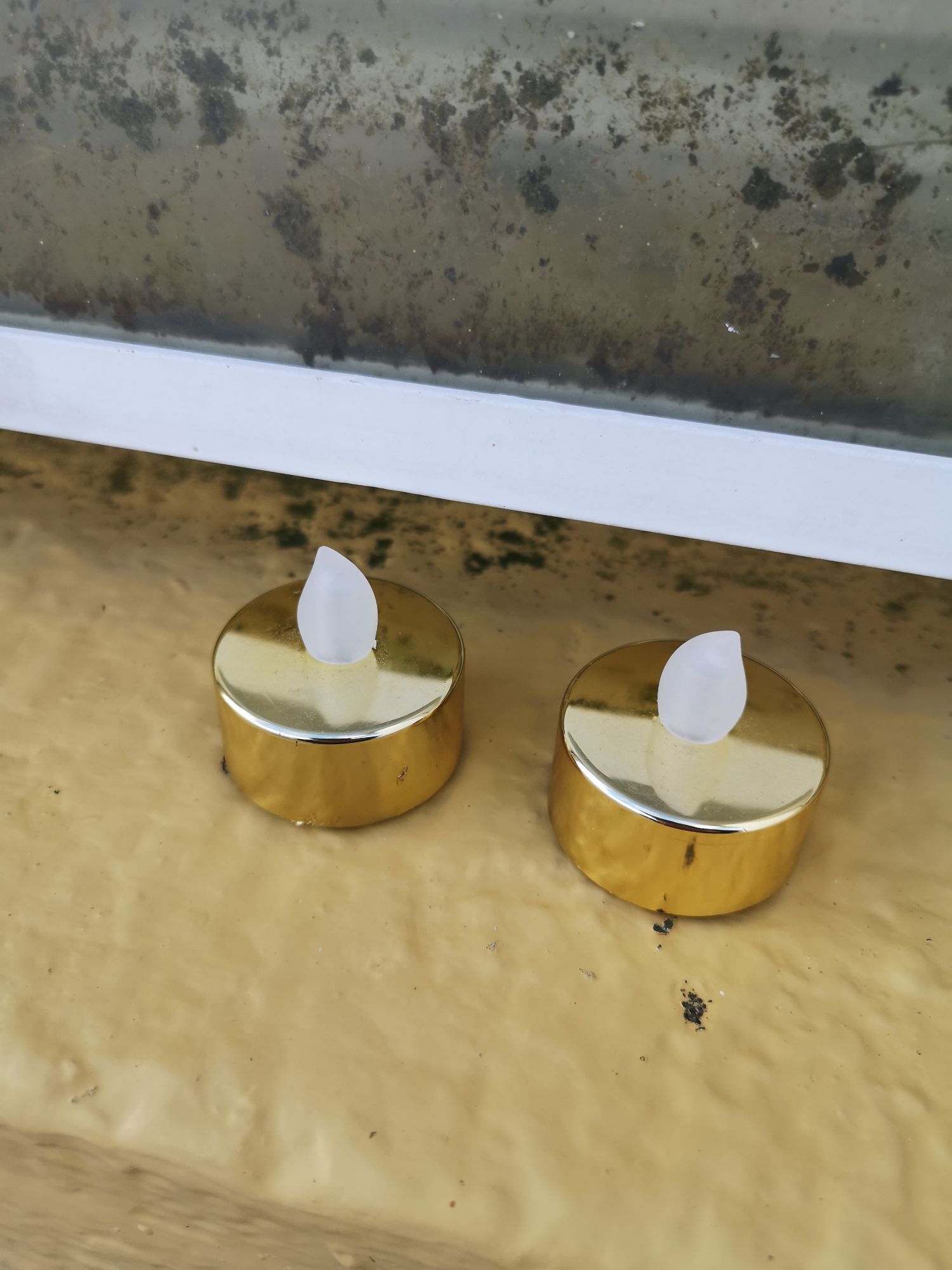
When we reached the North light, after a long trudge, I took a couple of little electric tea lights out of my pocket and we ‘lit’ them. (It was VERY windy so any traditional candle lighting would have been impossible.) What meaning to make from this small pilgimage?
From light to light. The light that is within all light.
From the south to the north, from one place to another.
Remembering the old, including it. Moving towards the new, trancending it.
Along the way, we met, we refueled, we paused, we encountered. A man showed us his lovely garden.
Next, I walked the high north cliff tops. Michaela lost me for a while and became convinced I had gone over into the sea below, wheeling with gannets, guillemots and shags.
We followed the high parts back down the island, heading for our temporary home.
As further adventure into the Celtic wisdom tradition, and as someone who writes poetry, this post attempts to describe another point of diversion from the religion I inherited.
Western Christianity has built itself on an altar of propositional truth. In order for this to be replicatable, this truth required sources and proofs which were all taken from readings of scripture. We can debate whether these readings were correct, but we can do something even more fundamental and question the approach entirely. What if the truth we seek is as much obscured by these readings as revealed?
Surely we can agree that the Bible alone is not sufficient, that we need so much more in order to form an idea of who and what god is and how to live well in the context we find ourselves in?
If this were not true, how are we in the mess we are in?
In his book Sacred earth sacred soul, John Philip Newell says this;
In the Celtic world, the imagination is a faculty of knowing. It is a way of remembering what we have forgotten, that spirit and matter are interwoven and that time and eternity are intermingled. The imagination is also a bridge into the future, forever opening us to ways of seeing and living that we have not experienced. To be made of God is to be made of sacred imagination. It is to have the capacity to dream our way to new beginnings, in our lives and in our world
(Ch 5 Pg123)
This is a hard pill for most of us to swallow. After all, most Christians from my protestant background have developed an epistemology – perhaps unwittingly – that replaces the trinity with a quadranity, with father, son and spirit subordinated to a fourth and most important part of the ‘trinity’ called the Bible (or ‘The Word of God’, or ‘Holy Scripture’.) There are countless examples accross Christian history of how this has gone wrong, how we have used readings of scripture to justify oppression, slavery, greed, conquest, antisemitism, racism, sexism, persecution of people of difference – particularly LGBTQ people. Recently I listened to someone describing how their Christian faith taught them how man, having been given dominion of the world, had a duty to make full use of the world resources – to tame the forest, to suck out all the oil, to mine gold and coal. To do so, it would seem, was ‘biblical’.
It is hard to escape the conclusion that we have sometimes, if not often, confused the medium with the message. We have elevated our own intellectual ego-centric readings above any sense of the wider principles contained within the swoop of scripture. We have obsessed over individualistic moral right/wrongs but ignored society-wide injustices.
This is not to say that injustices were absent from the Celtic world – the romanticism of Celtic hindsight is certainly worth resisting. But good water might yet come from old wells, so please let me make an argument (arising from Celtic wisdom) for poetry.
Perhaps we should start with the Hebrew scriptures, remembering that one third of the Bible- every third page – is poetry. What does this mean and how should we read this material? Is it ‘different’ is it less true, or true in a different kind of way?
I don’t want ot get too bogged down in the technical side of how poetry is thought to work in the Bible, but if you are interested, there is a good series from The Bible Project here. This is the first vid;
Does this mean that we can treat the ‘truth’ of those passages written as poetry differently? Not necessarilly. Most (if not all) of the poetry is in the Old Testament, although it is quoted in the New. We can be pretty sure that those who read the original knew that they were supposed to engage with those passages with their poetic antenae fully raised though – to let it fire their imagination, their passions. To let it do the work that poetry does through multi-layered ambiguity as much as through any propositional certainty.
There are some who believe that our Biblical ‘poetry blindness’ has resulted in multiple problems for Western Christianity.
And indeed this is just what Michael Edwards says in The Bible and Poetry, a short but hugely ambitious book whose aim is essentially to correct the course of Christianity. (Edwards, the only Englishman ever elected to the Académie Francaise, is a winningly candid Christian and interprets Scripture in that context.) Poetic illiteracy, according to Edwards, is not simply an individual problem but an institutional one. Christianity has developed as a religion of precepts and articles of faith. It has been defined and determined by systematic theology, an enterprise that Edwards believes—from Aquinas to Calvin and right through the present day—is simply an “error.” There is, he thinks, a reason that God chooses poetry to speak to us. Understanding this reason might not only lead to spiritual consolation and clarity for the individual believer but might even begin to heal some of our deep divisions.
There is another way to understand the role of the poetic as a tool for wisdom and spiritual engagement however, and this takes us beyond those who seek to ‘do the Bible better’, towards a kind of seeing that was perhaps more common within the Celtic world.
Poetry is embodied
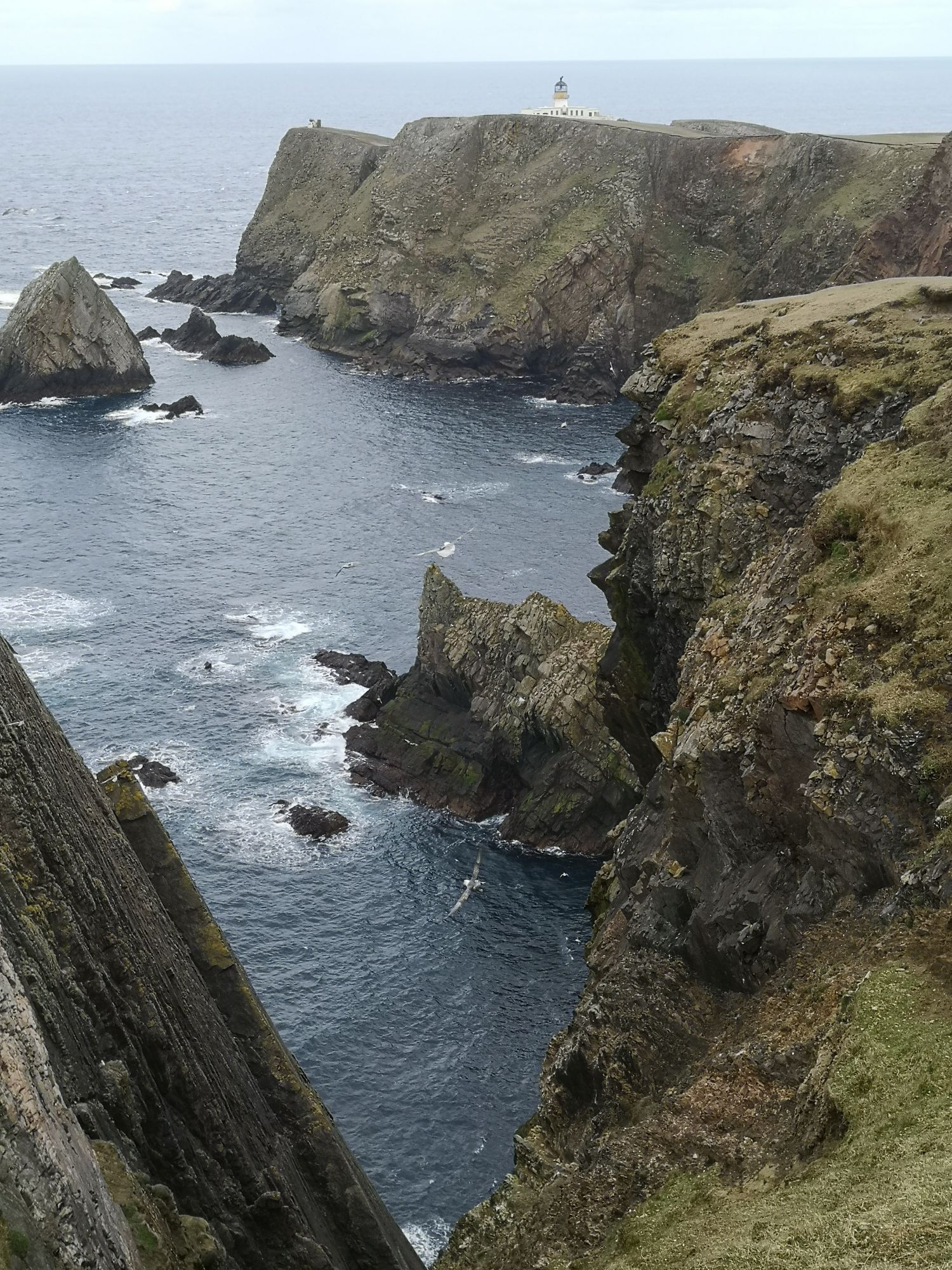
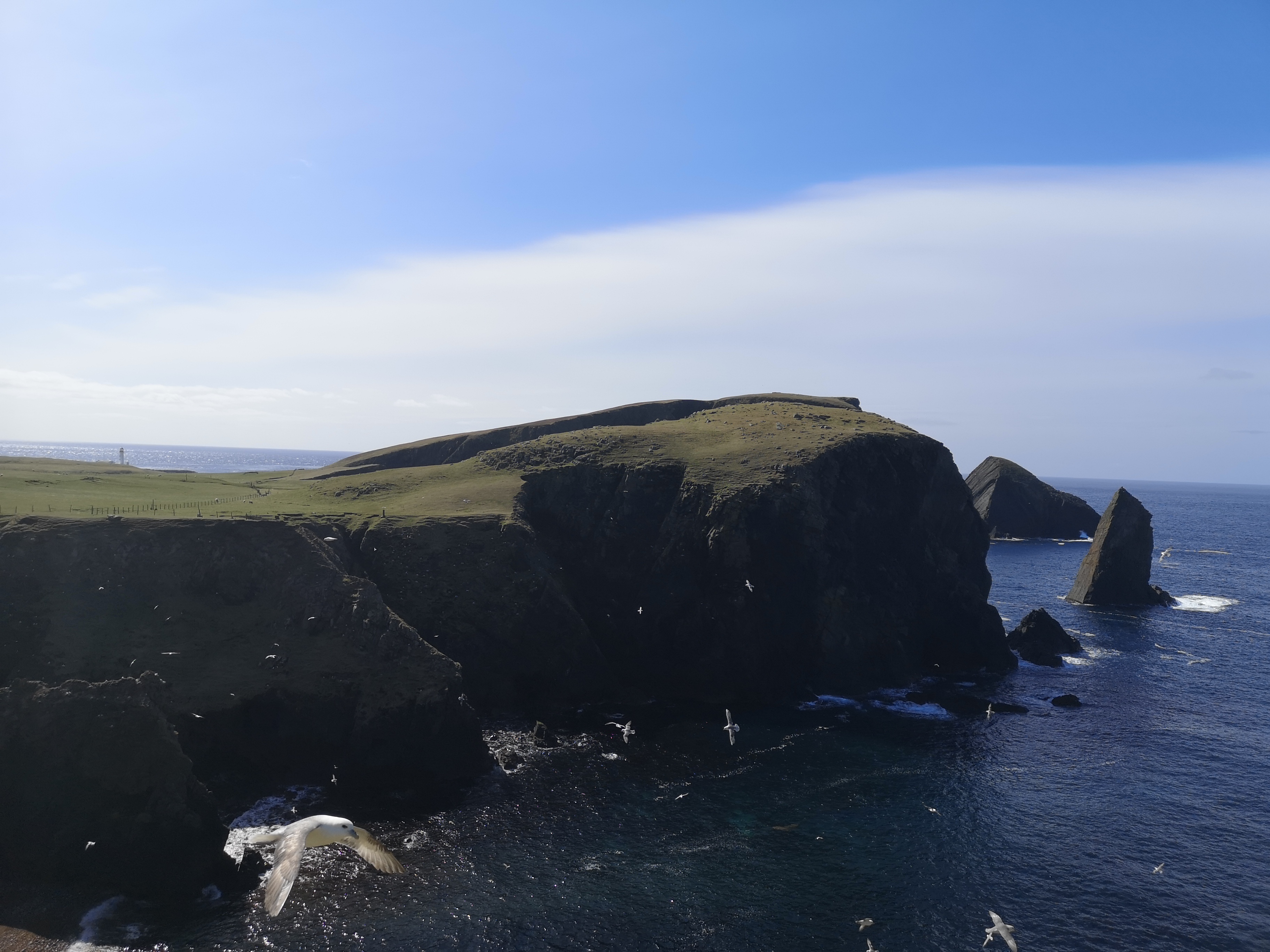
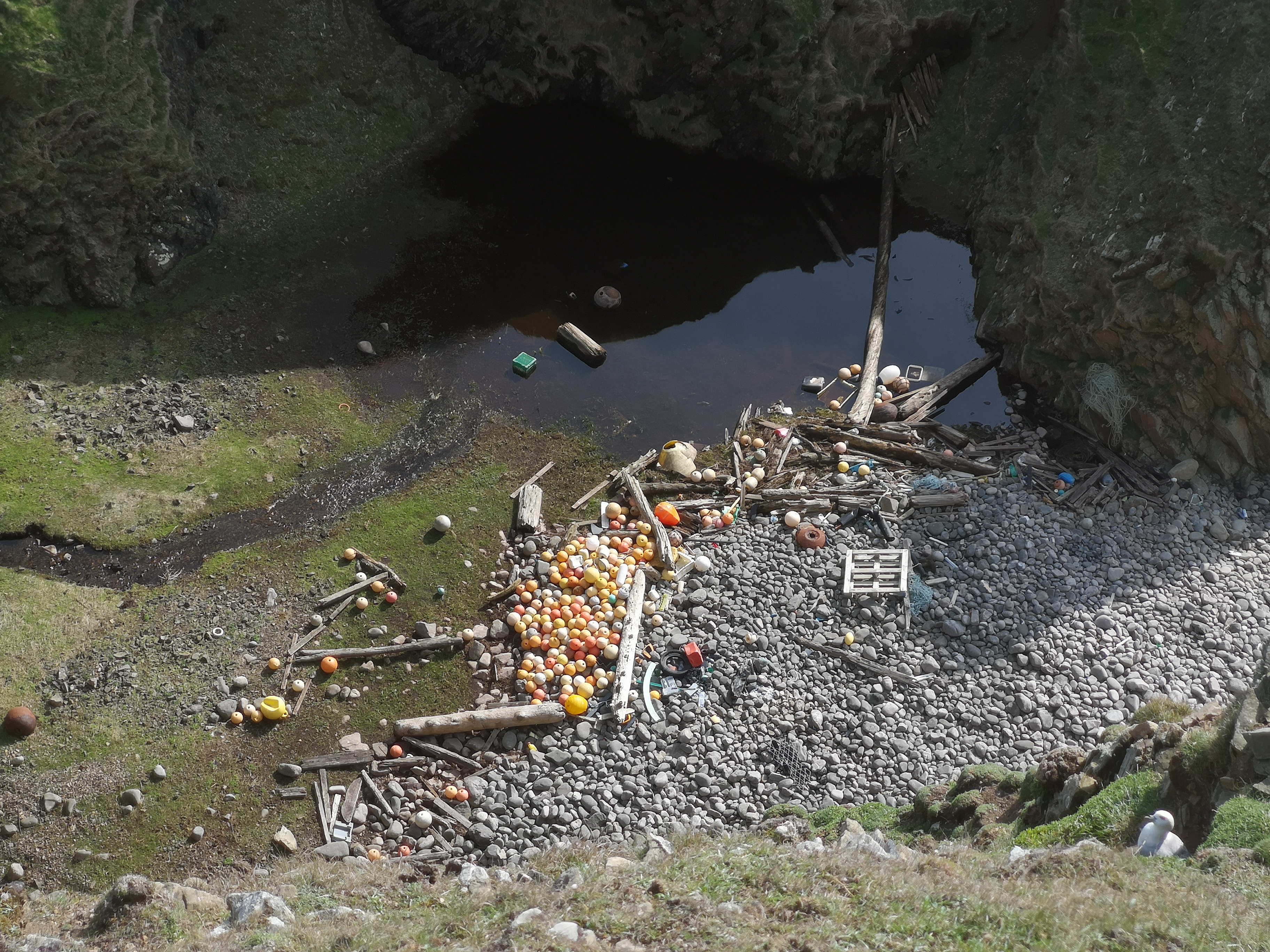
Standing in a place like the one where the above photo was taken, it is possible to say lots about the scene. We can name the bird (Fulmar) the rocks that make the cliffs (Sandstone.) We can describe by which processes the sea has sculpted the cliffs into caves, wihch then become arches and eventually collapse to stacks. We can describe the grasses and lichens. We can see the marks left in the land by past habitation and farming practices.
None of this information will tell you what it was like to stand on the edge of that cliff, clothes plucked by the wind, with hundreds of feet full of whirling birds straight down to a crashing sea. Neither will it tell you much about the soul of the place, the sense of being that it has and gave to me.
One is descriptive, the other is experience. One allows me to know things in my head, the other allows me to know things in my whole being.
It might be compared to the difference between knowing about something, to knowing something.
Poetry is mystical
I grew up in a tradition that regarded Irish Catholicism as empty superstition at best and demonic evil at worse, because of all the saint stuff and the icons and the holy wells. The idea that any of this might carry symbolic meaning was beyond reason, let alone the possibility that people engage with shrines or relics for mystical experience. The closest we ever came to the mystical was through charismatic craziness. (I tried some of that.)
What do I mean by ‘mystical’? The dictionary definition is ‘inpiring sense of spiritual mystery, awe and fascination’ but this is not adequate. Mysticism is a different way of seeing, a different way of knowing, often related to contemplative practice, art or encounters with nature and the wild.
It has been said that mystics accross the different world religions (all of which have a mystical tradition) often have more in common with each other than they do with other parts of their own tradition.
If there is a language that best communicates the mystical, it is poetry. The Sufi poems of Attar, Rumi, Hafiz, Sanai might be the best place to start- they are so fresh, so vibrant. Words written before Shakespeare yet (albeit in translation) could have been written yesterday. They come to us laden with longing for the divine, for union with the Beloved.
The Celtic tradition was an oral tradition, in which ideas of the divine were handed down, shared and celebrated using poetry. Many of these poems, prayers, incantations, songs, spells were gathered and recorded in the late 19th C by Alexander Carmichael into what we now know as the Carmina Gadelica. Perhaps people used these words for practical reasons- to mark the changing seasons and other threshold experinces such as birth or death or even the dawn or the keeping of the fire. It connected them to ancestors. But the nature of some of the words suggests a further purpose, in that they draw us beyond ourselves into a kind of knowing that is hard to describe in any other way.
Poetry is ambiguous
This might be partly because mysicism also deals with mystery, with unknowning as much as knowing. The things of God, of the divine, are not certain, they are less-than-half-percieved, or as Paul (who seemed to be pretty certain in other ways) puts it ‘through a glass darkly’.
Poetry leaves the field open. It leaves questions for us to grapple with. It uses metaphor and similie, allowing us to approach meaning from different viewpoints. Even more, it allows one thing to potentially have multiple interpretations, and none of them are necessarily wrong.
There is a generosity to this approach to spirituality. One that treats us as worthy of our own understanding, able to engage with the divine that we carry within us.
I am not suggesting we replace the Bible with poems. I am advocating for a poetic engagement with spiritual experience, one in which our knowing is allowed to be more fluid, more open, more embracing of wider possibilties and allows more room for mysical ‘feeling’.
Newell call this ‘flow’.
Years ago, I wrote a song based around one of the more well-known Iona blessings which (I think) is very old. I share it here not because of its poetic merit, but because it connects me with much of what I am trying to describe. It goes something like this;
Deep peace of the running wave to you
Deep peace of the running wave, running rising till it breaks on you
Deep peace of the running wave to you
.
Deep peace of the quiet earth to you
Deep peace of the quiet earth, dark green place of fresh new birth for you
Deep peace of the quiet eart to you
.
Deep peace of the flowing air to you
Deep peace of the flowing air, fresh and clear blowing through your hair to you
Deep peace of the flowing air to you
Deep peace of the shining stars to you
Deep peace of the shining stars, ancient light sent from afar to you
As part of my retreat on this beautiful island of peace, we visited a little museum set up by Fairisle inhabitants that can trace their stay on the Isle to the 1600s. It seems that their family, the Wilsons, began their time on the Isle when a man arrived here either through a shipwreck, or just because he was on the run, because he was a Covenanter.
(If you don’t know much about this stormy part of our religious and cultural history, here might be a place to start, as it concerns itself with a song about a shipwreck full of Covenanter convicts not far from these parts…)
No-one could accuse the Covenanters of lacking conviction, of deconstructing their old faith and standing unsure in the ruins. I have often wondered how they were so damned sure that they felt able to do difficult, even dreadful things out of that same conviction. They could face death, and they could kill. Even when their cause was defeated, they could stand tall, firm in the certain knowledge that God was on their side.
I think I used to envy this kind of conviction but now I despise it, even without the murder. I am reminded once again of that Nick Cave quote I used a few posts ago;
…the rigid and self righteous certainty of some religious people – and some atheists for that matter – is something I find dissagreeable. The hubris of it. The sanctimoniousness. It leaves me cold. The more unshakeable someone’s beliefs are, the more diminished they seem to become, because they have stopped questioning, and the not-questoining can be accompanied by a moral superiority… a bit of humility wouldn’t go astray.
So, please read the rest of this post with this firmly mind…
As part of exploring the Celtic Christian tradition, one of the most startling differences of view is the one I spoke about in the poem featured in my last post.
Let’s approach this from a different angle…
At the very centre of the deepest of us, we contain the divine – not in the sense of being ‘gods’, or because we are made-in-the-image, or even because we are built-from-the-substance-of, rather because this is true of all living, created things.
What implications does this have for spiritual practice, for how we seek truth, how we seek meaning, how we seek wisdom?
If we carry within us what is divine, then our search might no longer be external. It might be that wisdom is born within us, that it is part of the sacredness of our very being. Our job is to look for it within (and in others, but starting within ourselves).
To quote Meister Eckhart, the late 13th and early 14th century Christian mystic, “God is not found in the soul by adding anything, but by a process of subtraction.” By trying to get below or around all the stuff that gets in the way. If that sounds like therapeutic deism, then we need to get below or around that too.
Pelagius talked about three graces.
The grace of nature – the constancy of nature, the sunrise, the beauty we find in every moment
The grace of illumination, in which we awaken to a kind of seeing that we have forgotten, that invites us back into the great union of all things, back into relationship
The grace of forgiveness, when we feel that we can still live again out of our depths.
He thought that wisdom was born in all of us out of the sacredness of our being, that is is available to us by right… but he also felt that if the wisdom that we find is out of kilter with the example of Jesus, then we should look again, we should go deeper.
The implication here is that in the deepest part of who we are, we know.
We know.
When we encounter goodness, we feel it.
When we are faced with injustice, we are repelled by it.
There is a ‘yes’ inside me as I encounter this ancient wisdom tradition, and it takes me back to a list I made myself as a guide to deciding the ‘correctness’ or otherwise of a decision to steop towards the light;
I acknowledge those whose teaching/writing/leadership has inspired me, consciously holding on to those things I inherited that are ‘good’. These act like signposts or filters or channels through which I measure and encounter the new
What sings in my soul? I have decided to trust my own embodied reaction as a guide for accepting and adventuring. If I read something or encounter something and it lights me up emotionally/physically/spirituality (even intelluctually) then I will pay attention.
What is useful? By which I mean the degree to which ideas contribute towards my understanding of peace love and justice. If they do not seem immediately useful in this regard, I am not necessarily rejecting them as ‘wrong’, rather I am far less interested.
I think that this Celtic wisdom stuff ticks all three boxes.
But also I have to remember the Crown of London and all those Covenanters, then show a bit of humility…
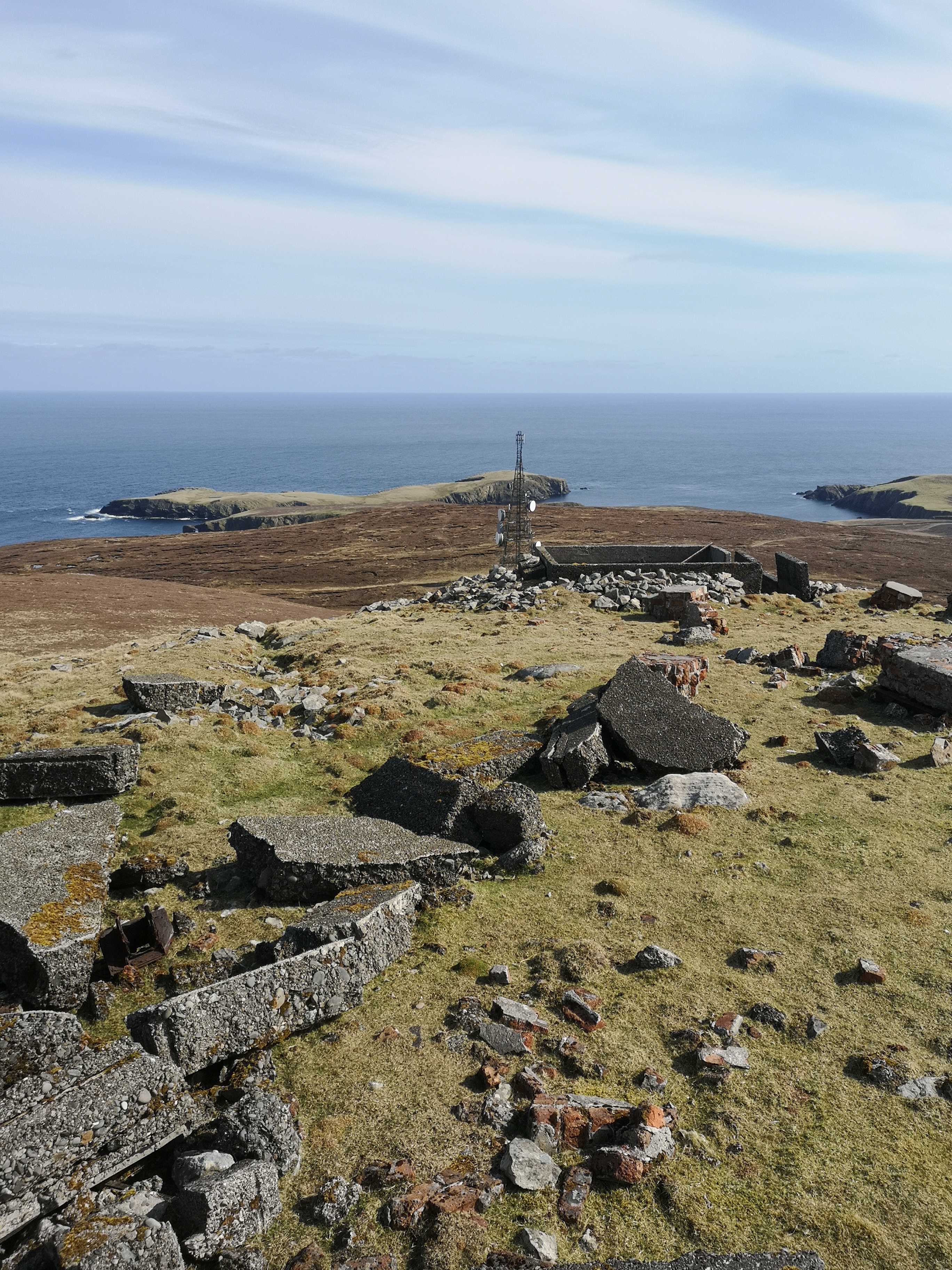
The splintered remains of the radar station on the top of Ward Hill, Fairisle
A poet dreams.
I dreamed I was 18 again, on the cusp of sitting my ‘A’ level exams, realising I had not done half the work and had revised even less. In my dream I was considering not actually sitting any of the exams, deciding that the whole business of formal education was flawed, going off and pursuing a different kind of life.
It was a vivid dream of the sort that stays with you through the day, as if it was true. I had to cut myself off from the anxiety and remind myself that education had been my escape back then, when it would have seemed impossible to me that following a non-conventional alternative path was possible for someone like me. The best I could hope for was to get as far into the world of certainty and salary as I possibly could.
It would be different now.
What on earth might this have been about? Well, what is the meaning of any dream?
My suspicion is that this one grew from a place of urgency around the deep desire for change. It was berthed in the turbulence of a mind grappling with some ‘new’ ideas (that are of course, not new at all, not even to me.) that hit me hard. That made me weep.
Old kitchen stove, WW2 radar station, Fairisle
It is a dream about vitalisation, of the sort that is rare, but that I seek above almost anything, in which I sense, amongst the ruins of what has been, the emergence of next.
I don’t mean this to sound like the cult of the new, rather it is the longing for better. I hear a splintering of what was before and an excitement about what might be coming, if only to me.
It is a longing for a way to connect spirituality with the natural world. Longing for the emergence of a Christian (or perhaps that word is too tainted) tradition that sees the deep sacred dignity in all living things, that stands against exploitation and greed.
A Christianity that might be part of the healing of each of us, not an excuse for the powerful to hide behind.
Looking down towards the new transmission station from the top of Ward Hill, Fairisle
What would the world look like if Augustine had lost the argument with Pelagius? What if we had never been convinced of our ‘original sin’, but instead built our thinking around the idea of original sacredness at the core of everything that has breath?
Without the empire that would we have had the religion of Christianity at all? What else might have filled this space?
What if the old Chritstianity is at the end of one of its natural cycles of existence?
What if it needs to be born again, and if so, who will be the midwives?
I have been immersed in these thoughts, so no wonder my dreams reflect this standing on the cliff edge.
Could it really be possible that we might see a new kind revival – not the sort that seeks to save individual souls from hell, by deleting sin through a cosmic confidence trick. Rather a rivival of remembering who we are and always have been.
A revival that rediscovers God in our souls not be addition, but by subtraction.
A gospel of grace, in which we remember that the God who is the light behind our light and the soul within our souls knows our woundedness, and waits for us to journey towards her.
A Christ who no longer is the deserter of earth, but an example of its greatest lover.
A Jesus who is no longer a supra-human ‘other’, but rather ‘us’.
A world in which nature is the gift of being, but grace is the gift of wellbeing.
But these are not doctrinal statemnents – what right, what skill, have I to pretend to such things. Rather they are raw material for poetry.
They are dreams.
They are flotsam on the shores of this beautiful sacred island.
I went a long walk today on a small island, up and down the high craggy cliffs that give you that feeling in your knees and belly (I love them, Michaela less so!) Most of the time that I was not caught up in wonder at what I was seeing, I was thinking about Celtic Christianity.
Why? Well, for several reasons I suppose. Firstly, I am watching the decline of faith in our culture with great interest. It could be said that what we are seeing is the end of Christianity as we have known it, and the question of ‘what next?’ is very much on my mind. In part this has made me interested in looking backwards as well as forwards, in this post for example, to a period before Christianty had yet become a religion. This looking backwards could also take me to the period before Christianty got in bed with empire, and to ponder the very different kind of faith that thrived for many centuries in the Celtic world.
I have also joined the stream of Celtic Christianity because of my associate membership of the Iona Community.
The other reason is because I am reading this book as part of my retreat;
The basic thrust of the book is to take us on a jouney though the history of Celtic Christianity, using key teachers as our guides, including these fine people;
Pelagius, one of the church fathers who fell out with Augustine (over original sin and things like that) and was eventually kicked out of the church, just as Mediteranian Christianity was concentrating is power in Rome.
Brigid of Kildare, who illuminates the interrelationship of all things and reminds us of the power of the sacred feminine to overcome those seeking to control us.
John Muir, who encourages us to see the holiness and beauty of wilderness and what we must do to protect these gifts.
…and many others.
The story here is rather fascinating, because even though the Celtic Church ceased to be a thing back in the 6th C (Synod of Whitby in 633 BCE) the ideas that formed and shaped Celtic Christianity never did. The thing is, perhaps when we need them most, ideas are reborn. If so, Celtic Christianity is very much worth a look.
Here is a great chat that gives some good background;
As for the book, I highly recommend it, not just because it introduces us to some fascinating people, but also because it reminds us that other ways are possible.
Before I came here, I veered from grandiosity (I am going to get the second novel started) to pessimism (I have nothing new to say about wild places.) So far, neither extremes have been realised, but I am daring to believe that this retreat is doing exactly what it needed to.
I decided to do the old notebook thing- capturing random thoughts and phrases. Letting them come to me and trusting that the well is not dry – no matter how often I have taken water before. Which of these words go on to be something else, who can say, but they are gathering.
Yesterday’s blog post was an exercise in taking some of these words and threading them together as thoughts. I then reduced them again in this poem, distilled them perhaps.
I wonder what meaning the poem brings if you read it first, and only then look back at the expanded thoughts that created it?
(I should add, this is also a ‘sketch’. It is certainly not a finished poem. I will pick at it, shift it about, perhaps take whole lines out or reshape them. But this probably won’t happen soon.
.
Small spirit, big spirit
.
I pick pebbles, thinking about democracy
I tend fire, wondering is light could be made for less
I stand before war graves on an island called peace
.
I ponder all those big theologies (like some pound shop Socrates)
That loom over my small conversation like steeples, or gilded minarets
Somehow, one does not cancel the other
.
Spirit has no shape
But know when it comes (even
If it was always there)
We know it in the pit of us
In our tiny hairs
Not experience, but meaning
Not meaning, illumination
.
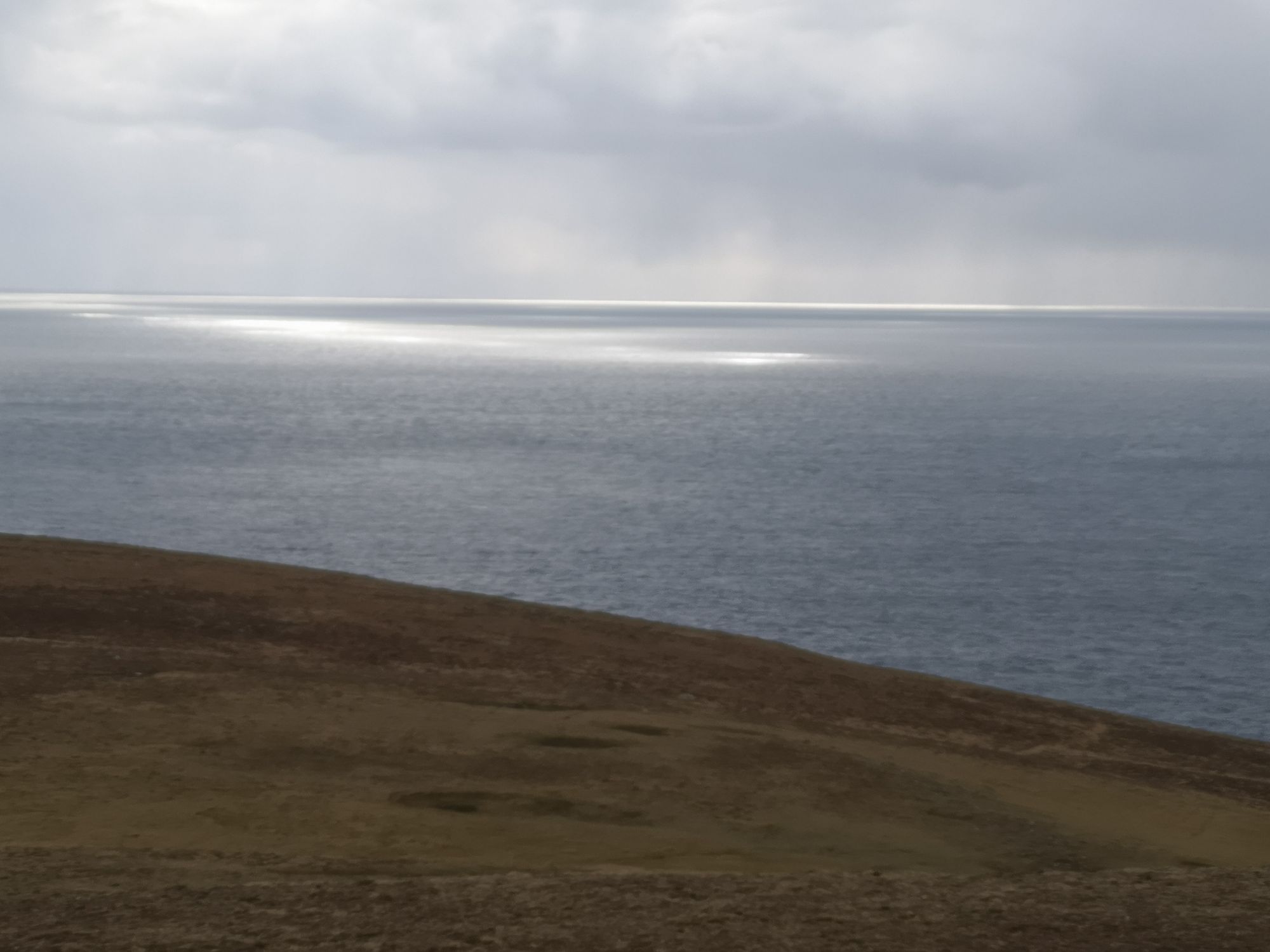
Big spirit is the big sea, as wide as grief
It is night sky. It kicks just where pain is greatest
It is chaotic joy. It is a child rolling downhill
.
Small spirit is bunting flitting in and out of reed beds
It is sudden gust of wind and a tearprick of kindness
It is seedling, a dog at heel, it is waves in the middle distance
.
The poet also walks a lot, out in the incessant wind.
Fairsle is small by any standards- just a few kilometres long, so that you are almost never out of sight of the sea, yet it seems to expand and shrink at the same time.
Perhaps this is because walking it is hard work – long swooping slopes and stomach swirling cliff edges, but it seems more than that, as if the contradiction is spiritual as well as geographical.
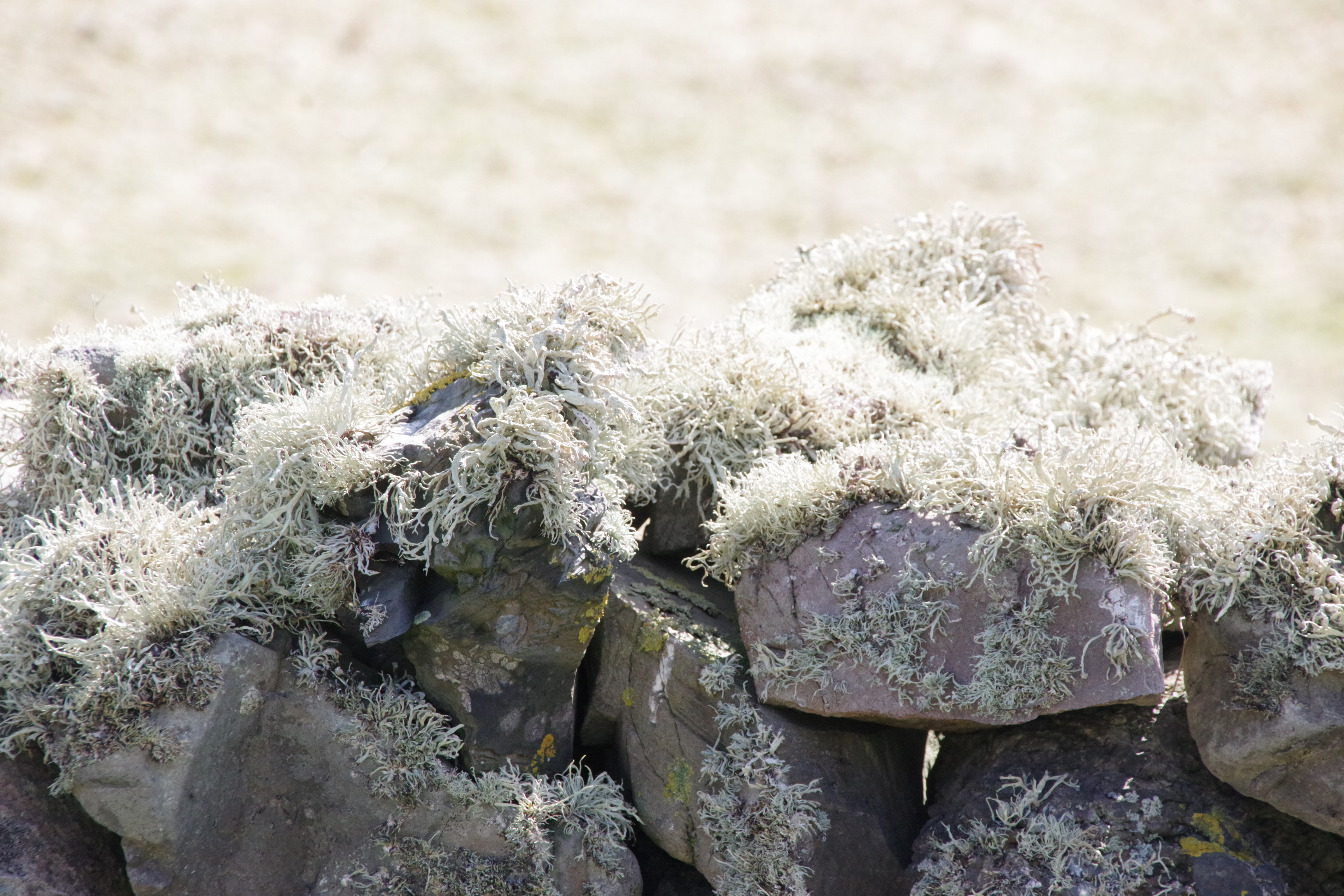
In places like this, out on the very edge, we find ourselves thinking small thoughts, like looking down at the carpet of tiny close-packed mosses and grasses that have been flattened to golf-green smoothness by weather and nibbling sheep. We huddle inside our cagoul hoods, wondering just how long it took for a bright orange lichen to spread halfway across a rock.
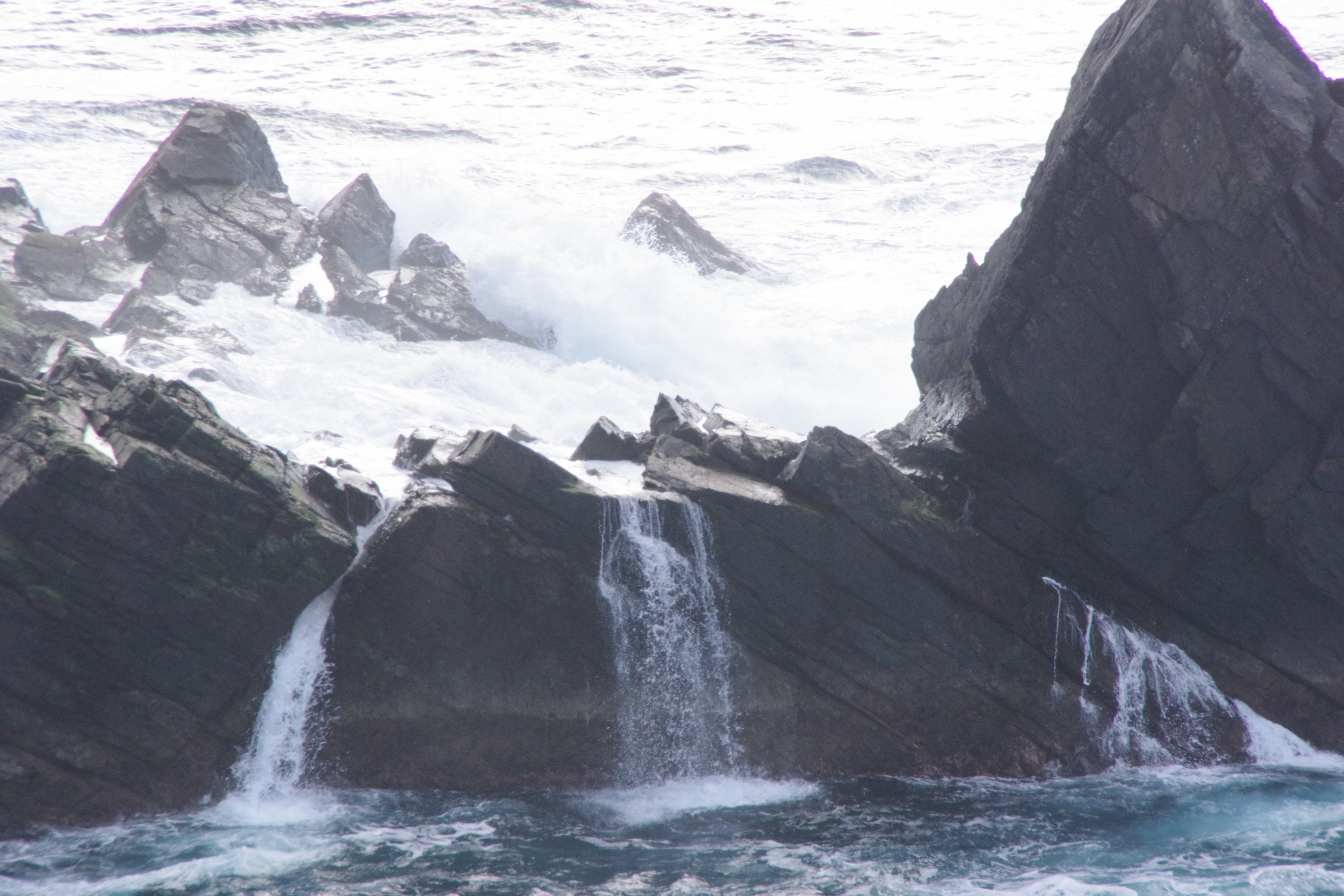
But then we look out over huge skies and seas. Our eyes finger their way along the ragged cliffs with their huge slabs of ancient sandstone and suddenly we are enlarged again.
So it is also with our thinking.
One moment I am picking up a pebble and wonering if it would make an ideal burnishing stone for pottery, the next I am thinking about what might be done to defend democracy from the mess we have made from it.
One moment I am tending a fire, wondering about the best way to deal with the ashes, the next wondering what can be done about the overconsumption of energy, and what it would take for the rest of us to limit our usage as is normal to the 60 or so folk that live on this island, who have to make their own sparks right here.
One moment I am standing at the graveside of people killed here in the second world war (two lighthouse keepers wives, some german airmen, a british soldier) wondering how a place called ‘peace’ (the name Fairisle being possibly derived from the Norse form Friðarey means literally “calm/peaceful isle” or “island of tranquility), then the next I am thinking about Gaza.
I remember how, years ago, I found something the the writer and theologian Karen Ward said helpful about the difference between ‘small theologies’ and ‘big theologies’.
Big theologies are those worked out over generations within institutional religion. They are constructued in linear progression, with each insight flowing into the next, sometimes through conflict, but mostly by academic study and broad consensus. These kind of theologies are recieved, given to us as absolutes for us to adopt wholy or to reject.
Small theologies are the work of communities. They are developed in conversations around tables and firesides. They are thrashed out over a pint or on long walks. They belong to people only becuase they make sense in a particular context and time.
The strange thing about these two theologies is that they do not (always) cancel one another. Both can exist at the same time. Partly this might be because they concern themselves with different perspectives – one the grand sweep, the other the small fold of ground – but also because it is possible to hold more than one view of something. Theological truth is always more nuanced than that – in my experience at least.
Absolutism is for facebook, not friendship.
I was thinking today about whether this dichotomy also existed within our experience of spirituality more generally.
Is this the same thing as theology? I don’t thing so.
When I use the word spiritual, I am trying to describe something that has no measurable shape. It has feeling though – the mystical, mysterious, pit-of-the-stomach, hairs-on-the-back-of-the-neck kind.
It is not experince itself, but what the experience means.
It is not meaning itself, but it is the illumination of meaning.
Big spirituality is like the big wide sea, the wide star strewn sky. It is immersive, transformative and catches us up in the chaos of trauma and grief. Big spirituality is a kick to the soul, right where the pain given is greatest. It is a small child rolling down a long grassy slope, right where the joy is most chaotic. These experiences are rare – thankfully so, because who can take this kind of spirit every day?
Small spirituality is like a bunting in the corner of your vision, flitting in and out of a reed bed. It is a quickening in a gust of wind. It is a prick behind the eye at a small act of kindness. It is a line of poetry or a seedling. It is a dog at your heel or the sound of a crashing wave in the far distance.
I am falling in love with this place. It is not hard to see why…
It is a place on the edge. Today the sun shone, but tomorrow is a different story. A big storm is heading our way, or so we are told by the man in the shop.
Already we are getting a feel for the people who live here. Some are born and bred islers, but many others have ended up here.
We had a conversation with one of the RSPB wardens the other day and I asked if he had seen ‘anything interesting’ which (despite my ignorance of most things bird) is an ornothological way of asking if there is anything rare to be seen in these parts. A silly question as the skies here are teeming with feathers. His answer intrigued me though, because he said that the ‘interesting’ birds only come in with a wind from the east, which blows birds over from Scandanavia and beyond.
It turns out that birds are not immune from the wind.
It turns out that birds, like people, are capable of being displaced, scattered, forced into alien places.
Birds can be refugees.
We are all outsiders elsewhere and birds are no different.
I was thinking about the deep connection thing again – how we are all part of The Christ, the god who loves things by becoming them; how the deepest part of all our individual beings is a one-ness with all things.
Or perhaps and am-ness that we share with all things.
It is easy to romanticise in wild places like this, to see the animals here as transcendent.











 this fragile tent